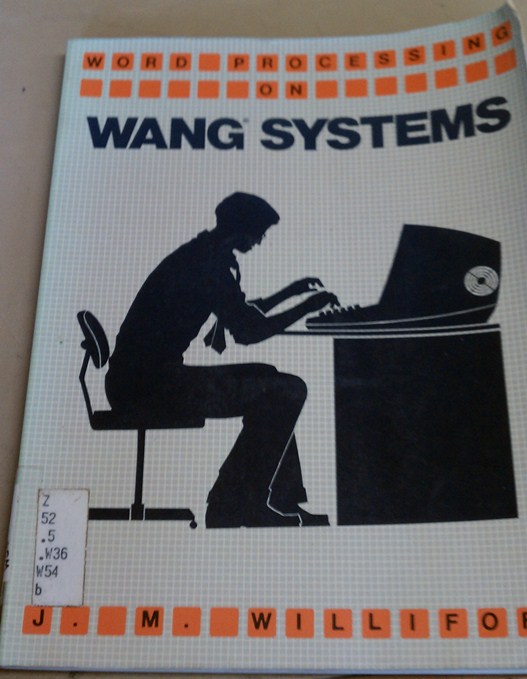
 Word Processing on Wang Systems
Williford
1984
Submitter: Now stop laughing, Beavis. Wang Computers are a real thing and were moderately successful in the 1980s. However, the company no longer exists, and most offices probably retired their Wangs in the early 1990s. THREE copies of this book were on the shelf at my library in December 2012, hiding in the “Z” (library science) call number.
This is from an academic library outside of North America. Our university was established in 1968, and our current library building was built in the mid-1980’s. Because of the need to build our collection basically from scratch, no one thought much about weeding in the first few decades. During the holiday break, I’ve pulled not only this gem, but also books on dBase, AppleWriter, VisiCalc, Lotus 1-2-3, Quattro Pro, WordStar, and other defunct software that hasn’t been in use for over 15 years.
While I can understand librarians thinking you don’t need to weed an academic library collection only a decade after moving into your new building, these should have been pulled when it became apparent that Microsoft Office had taken the market share away from these competitors and that the companies were no longer making/updating these programs. Ditto the 18 books I see in my catalog on using the Apple II (books date from 1981-1987, the last Apple II machines were manufactured in 1993) and all those internet searching books from 2000 that predate (and therefore don’t mention) Google. It’s embarrassing how much of this I keep finding on our shelves, sitting alongside the modern 21st century computing titles we’ve bought.
Some hints for librarians hoping to find and weed similar artifacts: LCSH headings for “Electronic data processing”, “Electronic digital computers”, “Microcomputers” and “Minicomputers” were much more common in the 70s and 80s than now, and anything with this heading may be laughably dated. While there are some theoretical and programming books that are decades old that are still useful in an academic library, when those subjects are on a book about selecting a microcomputer, computerizing your business, etc., it’s probably older than most of your students.
While you’re at it, beware of ancient manuals for software still in use: There hasn’t been an “Aldus Pagemaker” since Adobe acquired the company in 1994, and “Macromedia Dreamweaver” became Adobe Dreamweaver in 2005 (seven years ago!). Also, this old stuff isn’t necessarily all in QA 76 with the computer books: I’m finding 80s computer titles in HG (finance), TK (engineering), Z (library and information science), and LB (education, especially “educational technology” titles). Happy hunting!
Holly: Thank you, submitter! I agree with almost everything you said. I’m also laughing like Beavis. I’ll only take issue with the part about understanding that you don’t need to weed an academic library only a decade after moving into a new building. Now, I’ve never worked in an academic library, so feel free to enlighten me, but a DECADE is considered reasonable? Academic librarians, please tell us how often you weed, and to what extent.
 Awful Library Books